

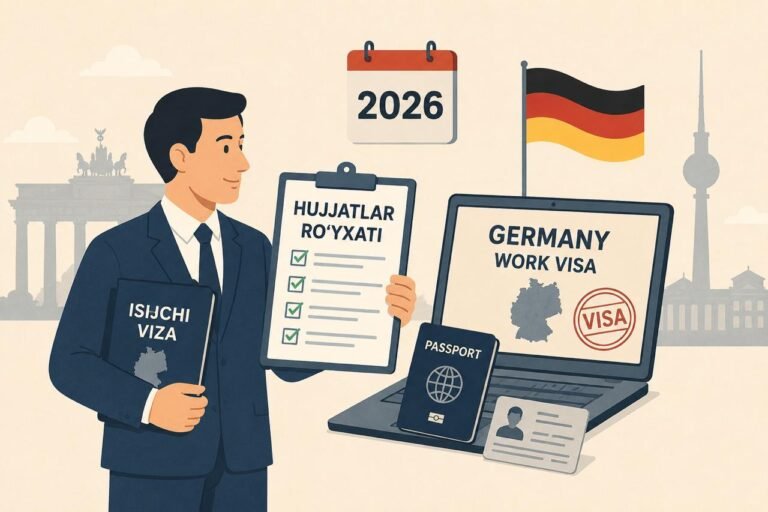
Moving to Germany for work involves several stages: identify your occupation and immigration route, find an employer, prepare documents, complete the visa process and organise life after arrival. Finding a vacancy and obtaining a visa are only parts of the process.
Uzbek citizens and many other non-EU nationals generally need an appropriate visa before entering for employment. Exceptions depend on nationality and existing status; work rights depend on the specific permission granted. (Federal Foreign Office)
Here is a practical preparation plan for working in Germany in 2026, from choosing a route to your first steps after arrival.
Step 1. Define your goal
Start by asking: which route fits your circumstances?
Turn the general wish to work in Germany into a specific plan. Possible routes include:
- a work visa under an appropriate route;
- a skilled-worker visa;
- vocational training (Ausbildung);
- qualification recognition;
- residence under §16d for relevant recognition measures;
- the special professional-driver route;
- recognition and adaptation measures in healthcare and nursing;
- the opportunity card or another applicable job-search route.
The official Make it in Germany portal explains skilled-worker visas, experienced-worker visas, the EU Blue Card and other routes separately. Their requirements should not be mixed together. (Make it in Germany)
For an initial assessment, ask yourself:
- Which occupation do I want to pursue?
- Do I have a degree or vocational qualification?
- What work experience can I document?
- What is my actual German level?
- Do I have a specific German employer?
- Do I need qualification recognition or professional authorisation?
- Which fits best: employment, vocational training or recognition?
An unsuitable route can waste time and money.
Step 2. Research demand and occupational requirements
Demand varies by occupation and region. Even where staff are scarce, overseas applicants must meet the vacancy and work-permission requirements.
You can research vacancies and training options in areas such as:
- nursing and healthcare;
- truck transport and logistics;
- construction and skilled trades;
- hospitality and catering;
- IT and technical occupations;
- manufacturing;
- electrical, mechanical and industrial occupations;
- vocational training;
- office and commercial roles where language and qualification requirements are met.
Healthcare and nursing particularly require language skills and professional authorisation. Drivers must separately check licences, professional qualification and evidence such as an FQN or valid Code 95.
Step 3. Choose the visa route
A key decision is the appropriate visa category.
If you have a qualified job offer and recognised or comparable qualifications, assess the skilled-worker route under §§18a/18b. Regulated professions also require authorisation. (Make it in Germany)
The experienced-worker route does not mean a qualification is always unnecessary. It generally requires a vocational or academic qualification recognised in its country of award, at least two years of relevant experience in the last five years and other conditions. Separate IT exceptions exist. (Make it in Germany)
For regulated professions such as medicine or nursing, first establish the recognition and authorisation process. If compensation measures are needed, §16d may be relevant; assess the subsequent employment route once the necessary approvals are obtained.
Step 4. Assess your German
Language matters for interviews, safe work and daily life. Requirements vary; language skills alone do not establish visa eligibility.
General guidance for planning language study:
- A1–A2 — basic communication; this level does not guarantee access to auxiliary jobs or a work visa;
- B1 — often the baseline for vocational training; check employer and school requirements separately;
- B2 — generally required for nursing authorisation; other roles depend on duties and employer requirements;
- C1 or specialist language — may be needed in medicine or communication-intensive roles; check the precise examination and responsible authority.
Assess your language early and plan for interviews, training and relocation. The level on your CV should reflect your actual ability.
Step 5. Find an employer
Many employment routes require a specific offer. The employer provides the contract, completes required forms and participates in further steps where needed.
Use several search channels:
- German job portals;
- company careers pages;
- verifiable recruitment agencies;
- LinkedIn and professional networks;
- vocational-training portals;
- direct company applications;
- partner organisations in Germany.
Verify the company’s legal identity and offer terms. Not every listing or employer letter meets the chosen visa route’s requirements.
The contract should clearly specify:
- position;
- employer name;
- workplace;
- gross pay;
- working hours;
- start date;
- contract duration;
- duties;
- required signatures and party details.
Step 6. Prepare employer documents
Employer documents matter alongside applicant records. In many cases, the company completes a Declaration of Employment (Erklärung zum Beschäftigungsverhältnis).
The Federal Employment Agency form records the specific offer and employment conditions. Competent authorities use this information when assessing the application. (German Federal Employment Agency)
Some routes have additional forms. For professional drivers, there is a Supplement C (Zusatzblatt C) covering information needed to assess the relevant case. Use the current version and instructions. (German Federal Employment Agency)
Recognition under §16d may require other evidence, such as a recognition decision or qualification plan, depending on the specific route.
Step 7. Prepare your personal documents
Prepare your file using the official checklist for your category and application location.
Depending on your case, these may include:
- passport;
- visa application form;
- biometric photograph;
- CV / résumé;
- degree or vocational certificate;
- work-experience evidence;
- language certificate, if required;
- motivation letter, if required;
- employment contract;
- Declaration of Employment (Erklärung zum Beschäftigungsverhältnis);
- suitable health insurance;
- initial accommodation details;
- translations and authentication required by the receiving authority;
- additional documents from the official checklist.
Each item is explained in our guide German work visa documents: a detailed checklist for 2026. You will find a link at the end of this article.
Step 8. Check document consistency
Having documents does not necessarily mean the application is ready. They must be legible, complete and consistent.
For example:
- experience in the CV should match supporting evidence;
- the role must meet the chosen immigration route’s requirements; a direct link to the degree is not required in every case;
- the stated purpose should match the visa sought;
- names, dates and roles should be translated consistently;
- pay and working hours in employer forms should match the contract.
Even minor discrepancies can require explanations and delay processing.
Step 9. Check the application procedure
The procedure depends on your country of residence, responsible mission and visa category.
Visa-required applicants planning a long stay generally need a national visa. A short-stay Schengen visa does not itself permit ordinary employment. (Federal Foreign Office)
For long-term work, assess the relevant national visa category rather than a tourist visa.
Find out in advance:
- which mission is responsible;
- whether online applications are available for your category;
- how to book any in-person appointment;
- the required document format and order;
- fees and accepted payment methods;
- which in-person steps remain after online submission;
- how to submit further requested evidence.
The Consular Services Portal supports online applications for a range of national visa categories. Check availability for your category and mission: uploading documents does not automatically replace appointments, biometrics or original-document checks. (Federal Foreign Office)
Step 10. Prepare for application questions
You may be asked about your purpose, occupation, employer, plans and documents. Be ready to explain your actual circumstances.
Be ready to answer:
- Why do you want to work in Germany?
- Which company is hiring you?
- What is the job title?
- What is the contractual salary?
- Where do you plan to live?
- How would you describe your German skills?
- How does your experience fit the duties?
- What are your longer-term plans?
- How did you contact the employer?
Answer truthfully in your own words. Explain errors or changed circumstances and provide corrected evidence where needed; do not rehearse an invented story.
Step 11. Await the decision
Processing may take weeks or months. Timing depends on:
- visa category;
- mission workload;
- document completeness;
- whether Federal Employment Agency involvement is needed;
- qualification recognition;
- employer documents;
- additional checks;
- individual circumstances.
A complete file can prevent some follow-up requests, but cannot guarantee timing or approval. Monitor official messages about your application.
Step 12. Prepare for arrival
After your visa is issued, check its details and conditions, then arrange:
- travel;
- temporary or permanent accommodation;
- start date;
- arrival arrangements with the employer;
- suitable health insurance;
- your first address;
- paper and securely stored digital document copies;
- important contacts;
- transport from the airport or station.
Plan address registration, health insurance, banking and onboarding for the first weeks. If a residence permit is required, contact the foreigners authority before your authorised stay expires.
Step 13. First steps in Germany
After arrival, settle into your accommodation, contact the employer and begin the necessary administrative steps.
Main tasks:
- confirm the start date and required work authorisation;
- organise accommodation;
- check the address-registration deadline and documents;
- confirm health cover;
- arrange banking details for salary payments;
- understand workplace terms and rules;
- gradually adjust to daily life and communication.
Adjusting to a new language, workplace culture and administrative system takes time. Ask the employer who can help with practical questions.
Common relocation-planning mistakes
1. Choosing an unsuitable visa route
First understand the differences between employment, vocational training, recognition and the opportunity card.
2. Unchecked employer documents
Errors or gaps in the contract and Declaration of Employment may trigger follow-up requests.
3. An inconsistent CV
Experience must be truthful and supported where required. Explain discrepancies early.
4. Underestimating language needs
Insufficient language skills can make recruitment, training, safe work and daily tasks harder.
5. Relying on unverified information
Check official sources and update dates. Another person’s successful application does not establish your eligibility.
How can Alman Visum help?
Alman Visum helps with documents and preparation for employment, vocational training, language courses and other suitable routes, including drivers and nursing professionals.
The agreed scope may include:
- explaining possible visa routes;
- an individual relocation plan;
- preparing an individual document checklist;
- help with a CV and, where needed, a motivation letter;
- application-form guidance;
- checking the completeness and consistency of contract and employer documents;
- interview preparation based on truthful information about your circumstances;
- pre-arrival planning;
- guidance on first steps in Germany.
Important information
Alman Visum is not a government authority, embassy or consulate. We do not issue visas or guarantee approval.
Services cover information, document preparation and organisational support within the agreed scope. Official decisions are made only by the competent German missions and authorities.
Your action plan
The sequence is: choose a suitable route, assess qualifications and language, find an employer, prepare consistent documents, complete the application and plan life in Germany.
Rely on official requirements and verifiable contract terms. A “guaranteed visa” promise does not replace an assessment of your case.
Start by reviewing your documents, qualifications, experience, language and budget. This helps establish a realistic plan and identify missing steps.
Planning to move to Germany?
If you are preparing for work or vocational training, Alman Visum can help explain the stages and organise documents. State your goal, qualifications, experience and whether you have an offer, then agree the scope and cost of support.
Alman Visum:
Email: info@almanvisum.com
Telegram / WhatsApp / phone: +4917664335685
SZB UG — international recruitment for Germany:
https://szb-nrw.de/
HireKraft — for employers and partners:
https://hirekraft.de/
LKW Fahrer Direkt — for truck drivers:
https://lkw-fahrer-direkt.de/
Alman Bildung — German language and preparation:
https://almanbildung.com/
YouTube channel:
https://www.youtube.com/@AlmanBildung
Instagram:
@almanbildung
@almanvisum
Official sources
- Federal Foreign Office — work visa FAQ:
https://www.auswaertiges-amt.de/en/visa-service/buergerservice/faq/07-arbeitsvisum-606666 - Federal Foreign Office — visas for Germany:
https://www.auswaertiges-amt.de/en/visa-service/215870-215870 - Federal Foreign Office — digital national visa applications:
https://www.auswaertiges-amt.de/en/newsroom/news/2692292-2692292 - Make it in Germany — visa categories:
https://www.make-it-in-germany.com/en/visa-residence/types - Make it in Germany — work visa for qualified professionals:
https://www.make-it-in-germany.com/en/visa-residence/types/work-qualified-professionals - Make it in Germany — visa for professionally experienced workers:
https://www.make-it-in-germany.com/en/visa-residence/types/visa-professionally-experienced-workers - Federal Employment Agency — Declaration of Employment:
https://www.arbeitsagentur.de/datei/erklaerung-zum-beschaeftigungsverhaeltnis_ba047549.pdf - Federal Employment Agency — Supplement C for professional drivers:
https://www.arbeitsagentur.de/datei/zusatzblatt-c-zum-formular-erklaerung-zum-beschaeftigungsverhaeltnis_ba047011.pdf

Pingback: Anabin: why check the university and degree separately?