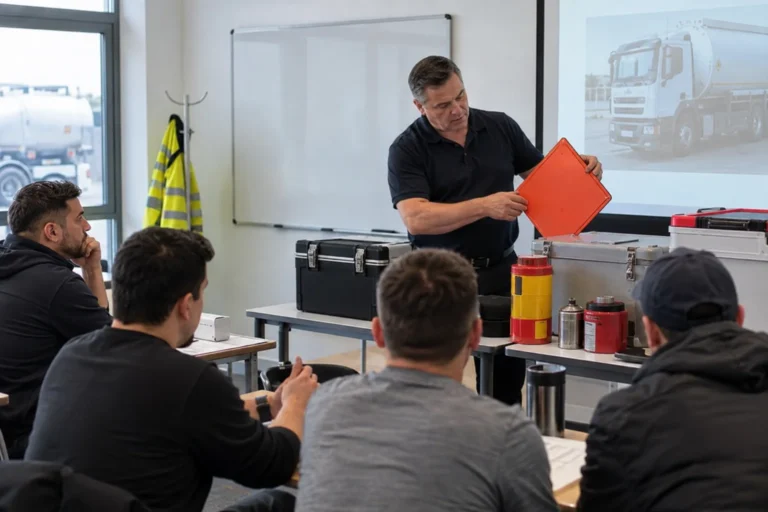

The aim of your first day at a new company is not simply to take the keys and set off. Even experienced drivers need to learn the vehicle, internal procedures, communication channels and paperwork. Previous experience helps, but does not justify guessing a new employer's instructions.
This checklist is for organisational induction. It is not a complete guide to vehicle inspections, load securing, tachographs or emergency action. Follow the appropriate formal training and current company procedures for those tasks.
Know whom to contact before your first day
Get the arrival address, time, welcoming contact and required documents in writing. The office and vehicle depot may be separate. Check the entrance and visitor procedure; do not follow another vehicle into a restricted site without permission.
Ask what clothing and protective equipment to bring, what the employer supplies and whether sizes are needed in advance. Find out the programme rather than assuming the first day is only a conversation.
Save a contact for problems getting there. Is there a backup if your only number does not work? This simple preparation reduces uncertainty on the morning itself.
Separate documents from permission to perform duties
Find out who checks your licence, qualification, required cards and immigration work status. Sending a copy does not mean everything is approved. Clearly record any documents still pending.
An employee still qualifying does not have the same role as a fully qualified professional driver. Compare temporary contractual duties with the actual permission. Understand what you will do in practice, regardless of the job title.
Do not sign unread documents. Ask for an explanation if you do not know what you are confirming. Check how to obtain a copy and whom to ask questions; calling it “just a formality” does not explain the contents.
Map the responsible contacts
| Issue | Contact to identify |
|---|---|
| Daily assignment | Dispatcher or shift supervisor |
| Vehicle handover | Authorised handover employee |
| Fault or damage | Designated technical contact |
| Documents and pay | HR or payroll contact |
| Out-of-hours problem | Confirmed on-call contact |
| Safety question | Relevant instructor or responsible person |
One person may hold several roles. What matters is knowing their name and when to contact them. An urgent hazard may require a different response from an ordinary work question; learn the appropriate emergency procedure instead of simply waiting for a reply.
Do not leave contacts buried in a group chat. Store them accessibly using a company-approved method. Ask what to do if your phone is lost or there is no network.
Understand the vehicle handover process
Clarify which vehicle and equipment are handed over, how existing damage is recorded and who checks uncertainties. Record existing defects during handover under company procedures rather than trying to recall them later.
Ask for a demonstration of unfamiliar controls, assistance systems or equipment. Do not assume they work like the previous vehicle. Clarify matters with the responsible person until you are ready to act independently.
Do not limit technical checks to this article's general questions. Use the full company procedure and relevant training. Receiving the keys does not resolve an unclear safety situation.
Practise the assignment and communication tools
Where do new assignments appear, how are changes confirmed and who corrects errors? Ask for a demonstration of the company app in a training or safe familiarisation mode. Do not mix up your account with another employee's.
Find out who provides cargo documents, where proof of completion goes and what to do if the app fails. Do not move customer data into a personal messenger without permission. A convenient channel is not always an approved one.
Raise language difficulties immediately. “Könnten Sie mir bitte zeigen, wie ich eine Rückfrage zum Auftrag sende?” asks for a demonstration of sending a question about an assignment. Repeat the action with the responsible employee checking it.
Illustrative example: familiar vehicle, new process
Experienced driver Jamshid does not yet know the new company's app. He sees a changed address, but the old document remains in the folder. Rather than choosing whichever file looks newest, he confirms the valid assignment with dispatch.
That day he also notices damage not recorded at handover. He reports it through the company procedure and asks how it will be documented. The fictional example promotes checking assumptions, not making new employees suspicious.
At day's end Jamshid records three points: sending an app enquiry learned, assignment confirmed, on-call contact still being clarified. Keeping the unfinished item visible allows it to be resolved before the next shift.
Resolve outstanding questions at day's end
Briefly note the induction completed and skills still needing support. Do not mark everything complete just to fill the form. Ask for a practical demonstration of any process you have not understood.
The guide to the stages of starting work in Germany helps with organisational preparation before arrival. Obtain first-day safety and vehicle instructions through your own company's authorised training.
Questions and answers
Does asking many questions show inexperience?
Not knowing a new company's procedures does not erase previous experience. Be precise about what you know, which step is unclear and who must confirm it. This is more useful than saying “I know nothing”.
I signed the induction record but later had a question. What now?
Ask the responsible person again. A signature is not a reason to perform an unclear process independently. Request another demonstration or additional induction if needed.
What if I am asked to drive independently straight away?
First resolve outstanding questions about documents, permissions and induction. This article does not make an individual decision to set off; do not ignore safety uncertainty to speed up the work.