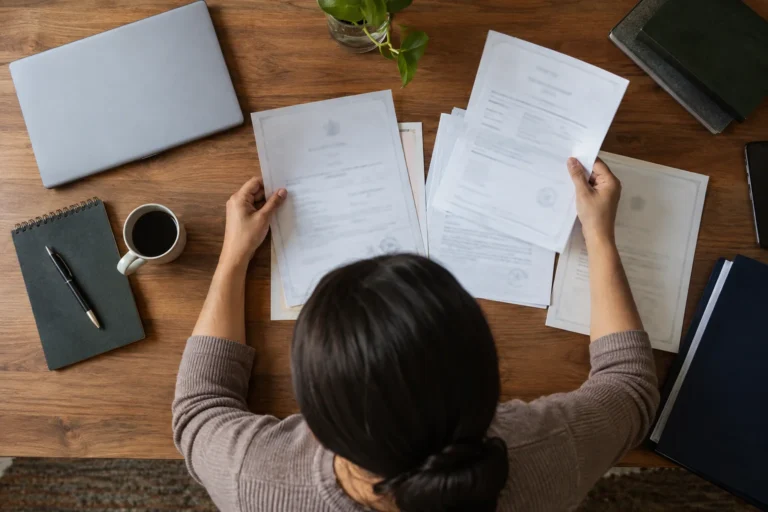

A diploma can confirm that you completed your education, but may not explain exactly what you studied. Subjects, grades, hours and practical training often appear in an attachment or separate record. A document file containing only the diploma’s attractive front page may therefore be insufficient.
This article helps organise evidence of your educational content. It is not a universal mandatory list for every visa or recognition application: the receiving authority determines what you need. The aim is to find information quickly and spot errors in copies early.
Distinguish the diploma from its attachments
The main certificate may show the degree, specialisation and issue date. Attachments provide more detail on subjects and study results. Their names, formats and contents vary by institution and period. Do not assume that every foreign attachment follows the same standard.
The official guide to documents for professional recognition lists subject records, study records and other attachments as evidence of the content and duration of training. Obtain the precise requirements from the responsible authority. For a ZAB evaluation of higher education, check the individual checklist separately.
Before ordering a translation, understand what each part is needed for. General information instead of a requested subject list, or a diploma alone instead of practical training evidence, will not answer the question. Prepare evidence that addresses the request.
Inventory every page
Lay out the diploma and attachments in order. Check fronts and backs, page numbers, stamps, signatures and continued text. Compare the file’s page count with the physical document. Include any notes on the reverse in the relevant copy.
A scan with a cropped stamp or text is incomplete. Carefully flatten a folded document without damaging it and scan again. If the original is illegible, contact its issuer rather than reconstructing the text from memory on a computer.
Compare personal details in the diploma and attachment. Investigate differences in names, document numbers or specialisations. A clerical error and a formal name change may require different solutions.
How do you check subjects and hours?
Distinguish subject names from hours, credits and grades. Retain the units used in the document. Converting credits into hours yourself or adding units from different periods without explanation can produce incorrect information.
If a total is shown, compare it with the subject list. A discrepancy does not immediately prove an error: practical training, independent study or another component may be counted separately. Request an official explanation from the institution.
| Information | Check | What should you avoid? |
|---|---|---|
| Subject name | Does the translation match the original? | Adding content |
| Hours or credits | Is the unit clear? | Arbitrary conversion |
| Grade | Are the symbols and scale clear? | Guessing a German grade |
| Practical training | Are the period and content stated? | Adding employment to educational placements |
The table helps identify questions, not edit documents. Do not alter official figures to suit your needs. Even a genuine error must be corrected through the appropriate institution.
What practical training details are useful?
Find records of the placement’s location, dates, content and role in the programme. A note saying “completed practical training” may not explain the work performed. If more information is requested, clarify exactly what needs to be proved.
Separate educational placements from employment after graduation. Both may provide useful evidence, but they are different periods and document types. Do not present an employer’s description of duties as a university curriculum.
A description of duties you write yourself is not an official certificate. It can be a note for a consultation. If formal confirmation is required, obtain it from the relevant institution or employer based on accurate facts.
Illustrative example: the hours do not add up
Suppose subjects and placements are listed in two sections, but the applicant scanned only the first. The total hours do not match the visible rows. This is an illustrative example, not an actual educational record or application outcome.
The applicant checks all pages and finds the missing section. They rebuild the complete file and update the page count in the translation order. They neither reduce the total nor invent missing subjects. The problem was an incomplete copy, not the document’s content.
Use the same approach for other uncertainties: check the copy, then the original, then obtain an official explanation. Guesswork corrections can create new contradictions between documents.
Requesting additional institutional records
Specify your study period, programme and the information required. “I need documents for Germany” is too vague. If practical training content is requested, include the exact requirement and ask what official record the institution can issue.
Allow realistic time. Retrieving archive records or identifying the successor to a renamed institution can take time. Tell the receiving authority honestly that the record is not yet available and clarify how to submit it later if necessary.
If the institution cannot issue the record, do not invent a substitute. Ask the receiving authority which alternative evidence it accepts. Options vary by occupation and procedure; another person’s experience is not a guarantee.
Translation and the final file
Give the translator the complete document and requirements. An official programme description can clarify an ambiguous technical subject name. Do not ask the translator to add qualifications absent from the original.
Check which original and translated pages correspond in the final file. Compression must not make small figures illegible. Keep the necessary, clearly named copies in the final folder. For the general visa file, consult the document guide, while your individual checklist takes priority.
Frequently asked questions
Is the diploma enough if its attachment is lost?
That depends on the receiving authority’s requirements. First ask the institution about obtaining a replacement attachment. Disclose the missing document during the procedure; do not assume it is unnecessary.
Should I convert the hours to the German system myself?
Do not change the units in an official document. Prepare any necessary conversion or explanation according to the responsible organisation’s instructions. One internet formula does not fit every programme.
Can I translate only specialist subjects?
Check which sections are required in advance. Removing a page you consider unnecessary may make the document incomplete. Selective translation is appropriate only where it meets the relevant requirements.
Can I omit low grades?
No. Do not conceal or alter the document’s content. Supply complete, genuine evidence. Check the purpose and criteria of the evaluation, but do not create a version that suits you better.